Welcome!

This blog is here for you to find fun learning activities to do with your children. We share great ideas we find and love on the Internet, as well as ideas we come up with on our own! We also like to share resources we find helpful.

To find ideas for your child, click on the age range blog label or on the theme/topic you are looking for (on the left side of the page). In each post, we try to list optimal age ranges for the activity, but you must judge for yourself if it is appropriate for your child. When you try an activity out, please comment and let us (and everyone else) know how your child liked it!
Showing posts with label writing. Show all posts

Wednesday, September 26, 2012

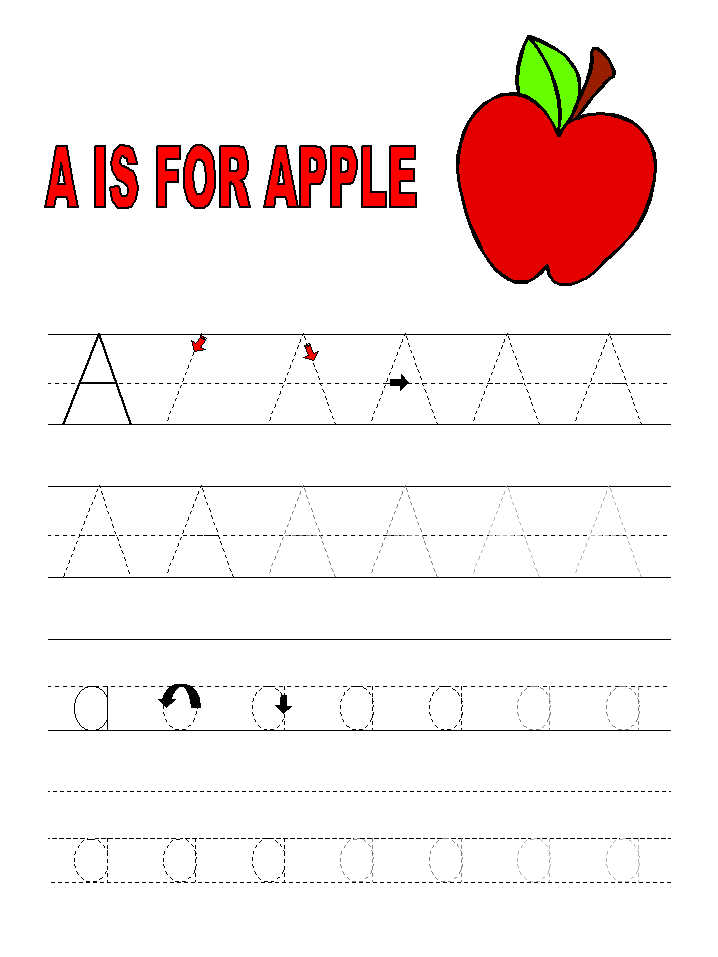
Letter Tracer Pages


DLTK-teach.com is a great resource for learning activities. I recently ran across their tracer pages and had a great idea. I have been printing them off and laminating them. I print them double sided--so A and B are on the same paper, C and D, and so forth. Then I laminate. Then my girls can use either a dry erase or a wet erase marker and practice letters. You can also use a permanent marker and erase with finger nail polish remover, but I am not the type to hand my kids  permanent  markers. 

This is a great thing to have on hand for learning time. It is also great when you are cooking something in the kitchen and your child needs something to do.

Wednesday, September 5, 2012

Letters: Angled Lines


The other day, I had McKenna (3) practicing her pre-writing skills as Raegan described in this post:

Pre-Writing Skills


Once she was doing a good job at connecting the dots, we started to practice writing letters. We did the straight lines (like T) and curved lines (like C) with no problem, but the angled lines proved tricky (like A). Since she had done well with the connecting the dots, I had her first write the letter by connecting the dots like we had done in our pre-writing skills practice. It really helped her see how you create the letters with the angle. You can see the progress in the photo I took above (with my phone). So if your child has a hard time with the angled line letters, give this a try! 

It could also be applied to straight line letters. Or you could do a series of dots to follow for the curved lines. 

Friday, March 9, 2012

Teaching Writing Sentences: When Are They Ready?

Please let me remind you that it's a process. It's not an overnight accomplishment, or even one that will come a month from now. Nervous? Don't be! Writing is so much fun and there is a huge sense of accomplishment (from mom and child) when you start to see progress.
How do I know if my child is ready?
Well, some of it will depend on you and your knowledge of your child. Some will never attempt (out of fear of not being perfect, not knowing where to start, not seeing examples, not caring) independently. Some will want to ("Mom, how do you spell... How do I write...?") but continuously ask you for guidance and help. How do you move the first (the never-attempters) and the latter (clearly ready, but at a standstill) to writing independently?
*If your child is not ready to write words yet, but can draw some shapes, see this site for great readiness worksheets. http://donnayoung.org/penmanship/redines.htm
I kind of do a mental checklist to see if it's time. This is just a guide!
1. Do they know their letters by sight (lower and uppercase)?
2. Do they know the sounds that match the letters?
3. Can they form each of the letters mostly the correct way (not counting backwards letters and development related mistakes)? Can they use handwriting paper to write letters? http://donnayoung.org/penmanship/handwriting-paper-bw.htm
4. For the most part, can they tell you the beginning sound of a word?
5. Do they attempt any writing at all (strings of random letters, labeling of pictures, etc)?
If so (especially 1-4), it just may be time to start!!
Pencil Grip (**You do NOT need to wait until letter/sound mastery to begin teaching this. Start as early as your child begins coloring/scribbling!)
I will be doing a series of posts on teaching writing. My first recommendation is to get golf pencils, especially if you are working on correct pencil grasp. Or, break your pencils in half (**gasp**). If you have fat pencils/crayons, don't use them. Small hands = small pencils/crayons. Giving a kid a regular length fat pencil is like an adult trying to write with one of those silly giant pencils you get at dollar stores. Smaller pencils/crayons encourage better grip. (For those of you trying to teach grip to a left handed child, remember that they should grip the pencil 1- 1.5 inches above the tip. Right handed children grip the pencil closer to the tip). Try to teach them to rest the pencil on the middle finger, rather than the ring finger. A little song we sing here goes like this, "My thumb is bent, pointer points to the tip, tall man uses his side. I tuck the last two fingers in and take them for a ride. I'm holding it just right, but not too tight..." (Handwriting Without Tears).
Helpful book:
Spelling Through Phonics (McCracken). I'll take a little more about this book and the principles during the next posts.

Friday, March 4, 2011

My Name is...


When we started working on spelling and writing my oldest daughter's name (and currently learning to recognize the letters in my middle's name), we tried an activity that we used to start the year with when I taught Kindergarten.
You also get the benefit of teaching glue skills ("a tiny dot, not a big splot" is what I tell her). Fun! (Note the slight sarcasm. Gluing can be very frustrating, so if you aren't up for it, I recommend a glue stick. Or glue in a lid and a cotton swab.)
I demonstrate first, and then let her go for it.
Write out their name as it should look on paper, twice. Cut up one of the names so they have blocks to glue. Demonstrate gluing and checking order of letters. I had her do it first without glue. Then I mixed up the letters and let her try it again. Once I saw that she had that part down, we moved on to gluing. She knows how to spell her name, but gets 2 of the letters mixed up. Gluing she loooooved, so this was fun practice for her.
For my barely 2 year old, it was a good chance to work on letter recognition and get some one-on-one instruction in another area while my oldest didn't need as much help.

Wednesday, June 9, 2010

Promoting Reading and Writing Readiness

Aaahhh. Reading. I love reading. I value reading so much. I truly believe that if you can read and comprehend what you read, you can accomplish anything. If you can read about it, you can learn about it.

The elementary school that my son will be attending this fall gave us parents a list of things to do to help promote reading and writing readiness in our children. Naturally, I will comment on each bullet :)
  • Read aloud daily for at least 20 minutes. This is so simple to make happen. All you have to do is have reading stories part of your bedtime routine. This means you have to make sure you start getting ready for bed early enough to include this.
  • Read expressively. Use different voices. Use and enjoy humor in the stories to engage your child. 
  • Re-read that favorite story. This is a powerful tool for fostering vocabulary growth. It also gets your child familiar with books and print. Children love repetition! I know, I know. Sometimes it almost seems painful to read that book again. I have felt giddy on library day, knowing we would soon have new books to read at night. But the kids love it, and it is beneficial for them.
  • Have your child retell a familiar story. There have been nights that I have had Brayden "read" the story that we were reading for the twentieth night in a row. Even though, as a three year old, he couldn't read, he got every, single word right. It was amazing. If your child isn't prone to verbatim story telling, that's okay. Have her tell the story in her own words.
  • Encourage word play, rhyme recognition, sentence completion, and word and phrase repetition as you read. You can also do this as fun learning activities in the day. Word play can be confusing on the surface sometimes, so I will do a separate post all on word play. Rhyming is pretty straight forward. You can read books full of rhymes and you could also ask your child what rhymes with a key word in the story. For sentence completion, this is where reading that story over and over can come in handy. You can start a sentence and then stop and let your child fill it in. Word and phrase repetition can be done by you, but there are also a lot of books out there that repeat things in the story. Boyton books come to mind (Barnyard Dance), as well as Seuss books (Green Eggs and Ham).
  • Discuss the story with your child as you read. Note illustrations and story elements, such as characters, settings, and sequence of events. This helps develop strong comprehension and critical thinking skills. There are typically pictures in a story that are not spoken in the words. Ask your child if he noticed. One that comes to my mind is My Truck Is Stuck. The words of the story are about a man (well, a dog, but a man) whose truck is stuck. Different people try to help him and in the end a tow truck arrives. The pictures show that a bunch of little dogs dug a hole in the road that got him stuck. Then then emptied every last bone from his truck while he tried to get unstuck.
  • Use your finger to track the words you are reading. This reinforces the connection between the words you are saying and the print on the page. It will also show  your child that we read left to right and how to follow lines down a page.
  • Continue reading to your child. Once your child starts to read on his own, he still needs to be read to each day.
  • Use magazines and newspapers to cut out letters and pictures. Brayden did this often in preschool.
  • Provide writing tools like large pencils, crayons, and markers. Your child won't learn to write unless he practices, and he can't practice without the necessary tools.
  • Provide lined paper and blank paper. Again, your child needs tools to practice writing.
  • Encourage drawing. Encourage your child to illustrate his thoughts and memories.
  • Act as a scribe. Write sentences that your child dictates to you.
  • Encourage your child to write and illustrate books.
  • Encourage your child to write his first name. Now, this is very important, apparently. Have your child write his first letter capital with the following letters lowercase. The teachers said they spend at least half the school year teaching the children to write their names this way. It is so hard for them to get the children out of the habit of writing in all uppercase letters.
These are all simple, right? Now, don't get overwhelmed. I know there is a lot here. You don't have to do every single one of these things every single day. Some things, like reading, should be done every day. Many of these things can be done while you are reading the story. Start slowly. Start tracking the words as you read. Once you have that down, start adding some voices. Work through the list and add things to your days to help your child build his reading and writing skills.

Wednesday, March 17, 2010

Up and Down

Age Range: 18 months-3 years

Materials:
  • crayons
  • paper
  • cardboard
  • scissors
Preparation:
  1. Draw a skinny rectangle on the cardboard
  2. Cut out the rectangle (I found that a sharp knife helped me get started, then scissors did the rest)
  3. This creates a stencil of sorts that is fat enough for crayons to be used
Activity:

Place the stencil on the blank paper and grab a crayon. Trace up and down inside the stencil, saying/singing "Up and down, up and down" with the appropriate motions of the crayon. Let your child choose a crayon. If your child will allow, put the crayon in his hand and guide his hand going up and down just as you demonstrated before. Use less guidance as you see your child ready to do it independently. Show him the line he made using the stencil and crayon.

If his interest holds, try this going from side to side as well, saying "left and right, left and right" to work on directions.

Skills:
  • fine motor
  • pre-writing
  • position/direction


I took this last one because at the time my son was holding the crayon perfectly, just as you would grip a pencil to write. Of course he moved his hand a bit right as I took the picture, but you can see that he's not holding the crayon in his first and is putting sufficient pressure on the crayon even if the angle is slightly off. Using enough pressure is something he's had to work into, I've had to explicitly encourage and demonstrate that since he began coloring at 12 months. If you do this activity with an 18-24 month old they may or may not have good pressure on the crayon yet. That's fine, it's one of the benefits of letting kids color actually.

As for the hand position, there is no need to force correct hand positioning at 2 years old, but just look at your own hand as you naturally hold the crayon. Keep it in mind and when your child seems open to it try to gently guide your child to holding the crayon similarly. Bad grip habits are annoying to overcome in kindergarten and first grade. Somehow my son has always had a pretty accurate grip at least 50% of the time with little explicit instruction on my part. It may be because I tend to color with him (yes, I know that may not be cool but hey, coloring is fun!) :) Sometimes an accurate example to model is all a child needs. Most kids need some sort of real practice and instruction at some point. In fact, I hold my pencil incorrectly to this day because of my kindergarten instruction (or lack thereof)! As you can see in the photo below Tobias is doing something similar, angling his hand down towards him, which makes it hard to write neatly. So for him I'll need to work on fixing that asap, mostly by trying to correct my own grip.

Thursday, January 7, 2010

Magnadoodle

Age Range: 1 and up


As a lover of all things neat and clean, I love the magnadoodle. It's a simple toy with lots of potential uses.

Activity:
  1. hold your child's hand around the magnetic pen and help him/her draw a counterclockwise circle. Practice this a few times, then see if they can do it themselves.
  2. Identify the shape as a circle, or the letter Oo, depending on your focus. Tobias' grandpa showed him this as an O so that's what Tobias calls it. In fact, he finds O's everywhere now, including shouting out O! because there was an O in the sign in the otherwise silent library. Libraries are too quiet anyway, right? :)
  3. Let your child have fun scribbling, even if their "O" looks nothing like the real thing that's okay.
  4. Continually reinforce the counterclockwise circle, it will make handwriting easier later on because letters with circles are drawn counterclockwise.

Extensions: sit on the magnadoodle.... what, that's not how they're supposed to be used? ;)

Tuesday, November 17, 2009

Pre-Writing Skills

Have you ever stopped to watch a young child color? Often times they color using their entire arm, in a scribbling motion. As they get older, the movement involves less of their arms and more of the wrists. Then gradually it becomes movement from the wrists and fingers, using very little of their arms and shoulders, if any. It's called proximal-distal motor development. Basically it means that kids learn to control the muscles closest to the body first (like the shoulders) before they learn to control the muscles that are far away from the body (like the wrist, hand, and fingers).

I am not an occupational therapist and don't claim to be. But according to some occupational therapists that I've spoken to and handwriting programs I've seen, there are a few shapes that need to be mastered in order to write. I don't know if they have to be mastered in order to be able to write, but it may help with neat handwriting and cause less frustration. Some of these shapes include vertical lines () , horizontal lines (-) , circles, X, +, and sloping lines like / and \. Activities that involve crossing the body's mid line (like making an X or sloping lines) take practice in order for children to make the shape well without switching hands.
In our handwriting program we used when I taught, we had children strengthen their arm muscles by using chart paper and practicing very large drawing vertical lines (from about their heads to about belly button level).
I did this activity with my toddler the other day. It was very interesting! I also noticed a definite difference in hand strength just by the amount of pressure she was able to put on the paper with her pencil. By the way, I recommend using a pencil or chalk for this activity instead of markers. Pencils and chalk help create drag, so it is an easy way to help strengthen their hand muscles as well (according to the OT at the elementary school where I taught.)


Materials: Chalkboard and chalk or paper and pencils. Large chalkboard (vertical) or chart paper or butcher paper (I use the back of wrapping paper in a pinch).


Prep: Draw dots to be connected in desired On a sheet of paper, draw dots to be connected on the pages. Start with vertical, which may be the easiest for them since they aren't crossing the body's mid line. As they get more proficient, move on to horizontal, sloping, crossing lines, and eventually making shapes (circle, squares, triangles, etc). I wouldn't try to tackle everything in one day, or even one week, unless you are dealing with an older child.
Example of dots in multiple colors to draw vertical lines:

Example for horizontal lines:


Example of lines to be connected to make a square:


Activity:

  • Show your child how to connect the dots. Tell them to connect the dots that are the same color. ("Touch the red dot with the pencil. Draw a line from this red dot to the other red dot you see.")
  • Try this activity on large chart paper or large sheets of wrapping paper or butcher paper, hung up on a wall or easel. The larger the shape, the easier it may be since kids develop muscles closer to the body first.
Things to notice:
  • Are the lines dark or very light?
  • Can they draw the line from one dot to another easily?
  • Which shapes (vertical, horizontal, sloping, X, etc) are easier? Which are more difficult?
  • Are the lines shaky or smooth?
  • Can they draw the lines in an unbroken movement, even crossing the body's mid line?
This is a great way to get ready for writing and strengthen shoulder, arm, hand, and finger muscles. This activity was tough for my 2 year old, but I've already seen progression as we've practiced. We've been doing it a little each day.
This activity doesn't have to take a long time. I have a piece of chart paper set up on the wall in my kitchen. Each morning with my daughter gets up, she can get a piece of chalk and draw a line from the top to the bottom. Quick, easy, painless, but very beneficial in the long run!

LinkWithin

Related Posts with Thumbnails